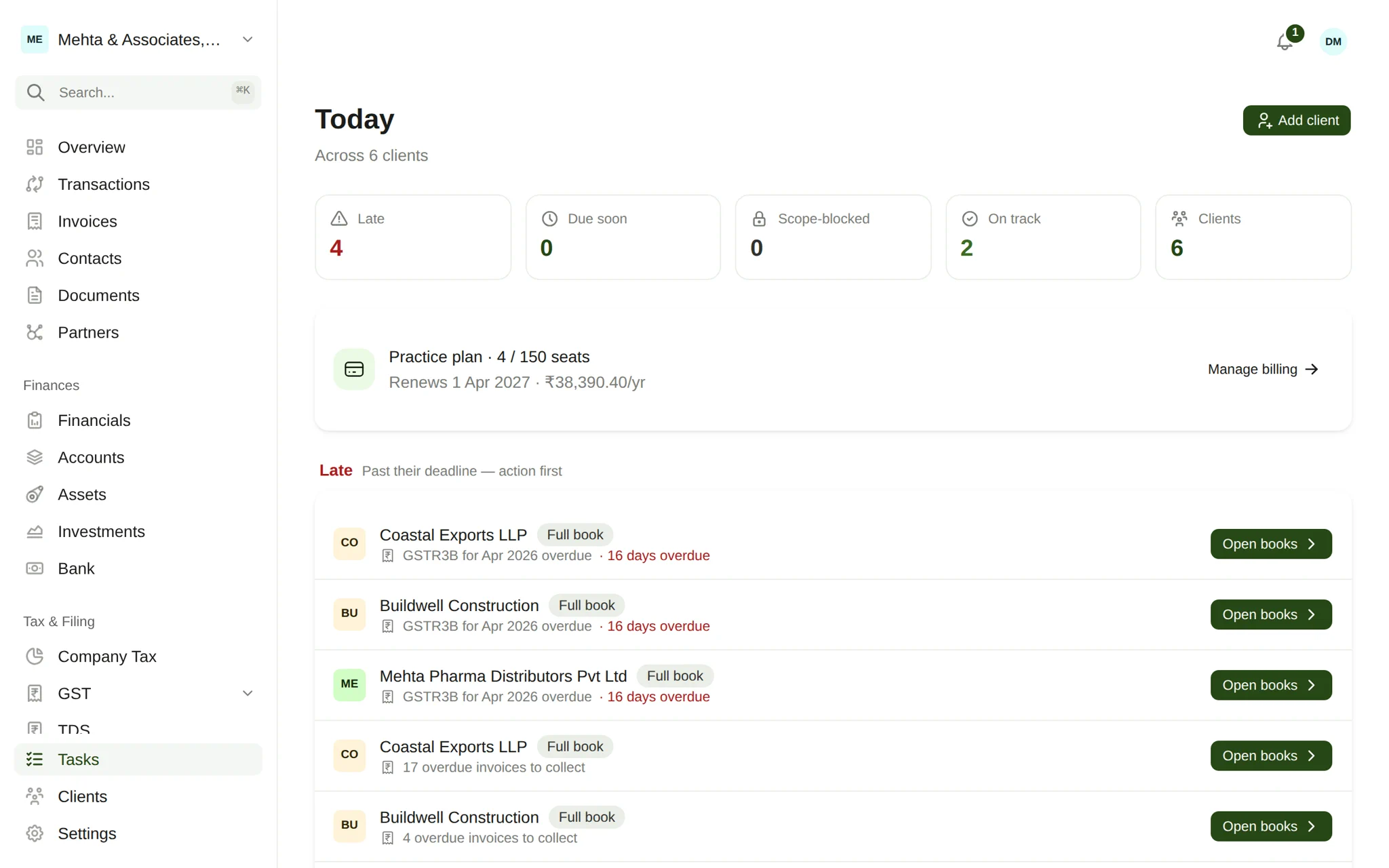
TDS is a calendar problem before it is a tax problem. The computations are usually straightforward; what breaks practices is the rhythm — deduct on time, deposit on time, file the statement on time, issue the certificate on time, for every client, every quarter, without exception. Miss one node in that chain and the cost lands on the client as interest, a late fee, or a disallowed expense.
The fix is not to work harder during the deadline week. It is to turn the recurring TDS cycle into an automated workflow so the calendar does the remembering. Here is the shape of that workflow. Treat the steps as process guidance, not statutory advice — confirm every rate, section, and due date against the current law before you act.
1. Deduct at the right moment
Deduction errors are the most expensive because everything downstream inherits them.
- Identify deductible payments at source. The decision to deduct should happen when the bill is recorded or the payment is made — not reconstructed at quarter-end.
- Apply the correct treatment for the payee and payment type, and capture whether a lower- or nil-deduction certificate applies.
- Flag threshold-sensitive payees. A vendor who crosses an annual threshold mid-year changes how you treat every prior payment to them, so track cumulative amounts, not just the current bill.
The cheapest TDS correction is the one you never have to make, because the deduction was right when the transaction was booked.
2. Deposit before the window closes
A correct deduction that is deposited late is still a default. Deposits are the most automatable node in the entire cycle.
- Aggregate the period's deductions per client and per section.
- Generate the challan with the right heads and assessment period.
- Schedule the payment comfortably inside the statutory window, never on the last day — portal outages and bank cut-offs do not pause for deadlines.
- Capture the challan reference against the deductions it covers, so the return practically assembles itself.
This is where automation pays for itself: the deposit deadline is fixed and known months in advance, so there is no reason for it to ever be a scramble.
3. File the statement and reconcile
The quarterly statement is where the deductions, the challans, and the payees all have to line up.
- Reconcile challans to deductions before you file — every rupee deducted should map to a deposited challan.
- Validate payee details (identifiers, names, sections) so the credit actually reaches the deductee and does not bounce back as a defective statement.
- File within the window, capture the token, and store it against the engagement.
- Watch for default notices after filing — short deduction, short payment, or late-fee intimations need a fast, tracked response, not a quarter-late discovery.
4. Issue certificates and close
The cycle is not done when the statement is filed — the deductee still needs proof.
- Generate and issue the certificates to each deductee on schedule.
- Confirm the credit reflects for the deductee, so a mismatch is caught now and not at their return-filing time.
- Roll the calendar forward. Log the next quarter's deposit and filing dates the moment you close the current one.
A practice that automates these four nodes stops treating TDS as a quarterly fire drill and starts treating it as a background process — which is exactly what it should be. Our data-in integrations and pricing are built around running this loop across a whole client portfolio.
FAQ
Which TDS deadline is most often missed?
The deposit deadline, because it sits between two more visible events — the deduction and the quarterly return — and has no on-screen prompt of its own. Automating challan generation and scheduling the payment inside the window removes it as a failure point entirely.
Why automate TDS if the computations are simple?
Because the failures are almost never computational — they are missed dates, un-reconciled challans, and certificates that never went out. Those are calendar and tracking problems, and a workflow that schedules and reconciles them automatically eliminates the entire class of error.
Does automation remove the need for review?
No. Automation handles the timing, the assembly, and the reconciliation; professional judgement still owns the treatment decisions and the final review. The goal is to free that judgement from the clerical load, not to replace it.
If TDS across your clients still lives in a spreadsheet of due dates, WeKeep is built to make that calendar run itself — deduction, deposit, return, and certificate in one tracked cycle. Join the waitlist to try it on your practice.